
This piece originally ran back in 2017. I’ve recently revisited it to update legacy information, swap out retired projects for active ones, and keep the science accurate for today’s hardware.
Volunteer computing is an arrangement where everyday users donate their unused computer resources to massive scientific projects. It’s a brilliant way to crowdsource the kind of heavy, time-consuming computations that would otherwise take research teams years to process. Most of these initiatives are spearheaded by universities and non-profit foundations trying to solve real-world problems—though a few are still chasing the cosmos.
My Journey into Distributed Computing
I’ve been participating in distributed computing projects for years, albeit on and off sometimes. My gateway was SETI@home, the famous UC Berkeley project searching for extraterrestrial intelligence. Back then, it ran on its own proprietary software before eventually migrating to BOINC (Berkeley Open Infrastructure for Network Computing). BOINC is an open-source platform that became the backbone for dozens of similar initiatives. Around the same time, I started contributing to Stanford’s Folding@home, which simulates protein folding to help research complex diseases.
Of course, the landscape has changed since I first started. SETI@home famously went into hibernation in 2020 after successfully completing its massive data analysis phase
Other early pioneers, like POGS and MindModeling@Home, have also wrapped up their runs.
Today, my BOINC client is pointed at a modern roster of heavy hitters. I’m currently contributing to World Community Grid, Einstein@home, ClimatePrediction.net, and Asteroids@home. I allocate my resources based on whatever scientific cause feels most urgent to me at the moment.
How BOINC works
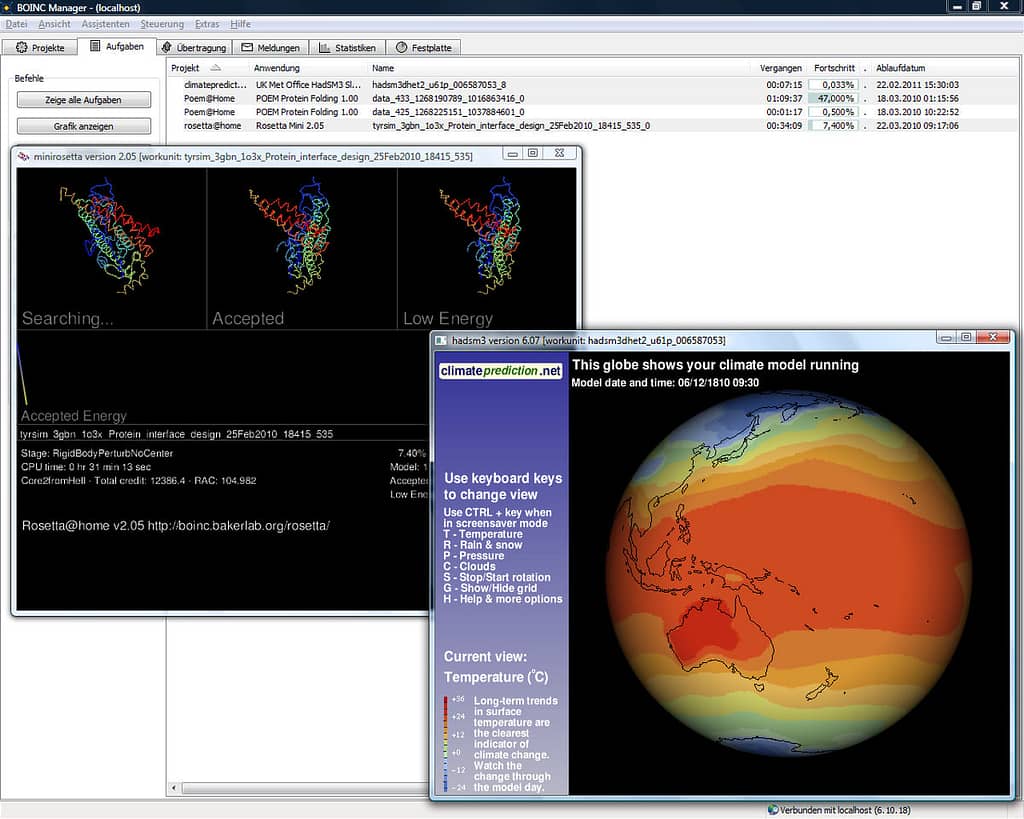
Once you install BOINC, you choose which projects you want to support. The software downloads a set of “work units” to your computer and starts crunching the numbers in the background. Once a task is complete, the results are uploaded back to the project’s server.
In return for your computing power, you get points. It sounds trivial, but the gamification works—it gives you a tangible sense of achievement. You can also join “teams” based on geography, shared interests, or tech forums. This injects a great sense of community and positive competition into the process (though, naturally, some prefer to be lone wolves).
Because of the sheer volume of PCs, smartphones, and tablets connected to the internet, volunteer computing networks routinely deliver more raw processing power to scientific projects than the world’s largest traditional supercomputers. The beauty of BOINC is that it respects your boundaries. You can configure it to only use your processor when the machine is idle, or tell it to pause entirely if you’re playing a game, rendering a video, or just need your battery to last.
The Value of Idle Time
By joining any of these projects, you aren’t sacrificing anything. You are simply donating your device’s idle time. In exchange, you become part of a global network researching diseases, tracking near-Earth asteroids, predicting climate change, and testing number theories.
When you participate, you are doing a world of good. There is no better way to put a sleeping computer to work.