
In the time I’ve lived in Qatar, I’ve visited government offices more times than I’d like to count. And I’ll tell you: in the last few years, things have changed dramatically… for the better.
A few months ago, I walked into a government service centre to sort out some paperwork—the kind of errand that used to eat an entire morning. I took a number, sat down, and before I’d even unlocked my phone to distract myself, my number was called.
The person behind the counter smiled. Explained what I needed, processed it, and I was out the door in under fifteen minutes.
The Old Routine
When I first came to Qatar, public services followed an almost scripted pattern. You showed up early, braced for a queue that barely moved, and dealt with staff for whom the transaction came first and you came second. It wasn’t malicious. It was just how things were. Paper forms. Physical files. Copies after copies.
That system no longer exists—or at least, not anywhere I still have a reason to visit. The rollout hasn’t necessarily been uniform, and I wouldn’t be surprised if pockets of Qatar are still catching up.
Digital Platforms
Metrash2, basic as its interface was, worked. It started slow. What used to take hours—if not a couple of days and a trip to a police station or the traffic authority—got sorted in minutes from your phone.
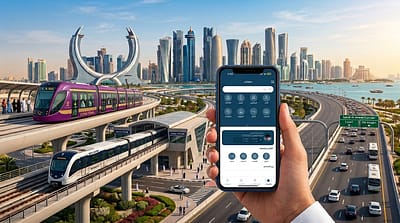
The new Metrash app is genuinely better designed. Cleaner layout, more options, fewer taps to get things done and hopefully, still being improved.
Getting Around
Doha Metro deserves its own paragraph here. Launched in 2019 in preparation for the 2022 World Cup, it proved its worth during the tournament’s crush of visitors. Its ridership kept climbing long after. It’s fast, very reasonably priced, runs on time, and in summer, the air conditioning alone makes the case for using it.
The MetroLink, the free bus network feeding last-mile connectivity into metro stations, is the cherry on top.
Pair that with the road network expansion, the widening of major arteries, and the increase in flyovers, and the thought of “add extra time minutes for traffic” has largely stopped applying.
Additionally, there is also the Lusail Tram services that are operating between Legtaifiya and Tarfat – South stations.
The Real Shift
Here’s what cannot be overstated, though: staff who once seemed focused on clearing the queue rather than solving the problem are now genuinely helpful. Questions get answered correctly. You’re pointed to the right department and there’s an attentiveness that simply wasn’t there years ago.
You can’t program that into an app. That’s the result of real capacity building, real training, and a decision that the person sitting in the waiting room deserves better.
Turns out, there’s a government bureau whose actual job is chasing that kind of improvement—reviewing old processes, training staff, holding departments to a standard. And since 2023, there’s even an award for it, one that scores agencies on service quality and how satisfied people walk out feeling.
Realistically, few years isn’t a long window for that kind of shift. However, sitting in that service centre, in and out in fifteen minutes, seeing smiles instead of frustration—it’s not just a new app rollout, but the upgrade that matters most.